The Billion Dollar Proof
Q2 2026 Earnings Review | Wiseman Cap

Three months ago I argued the 17% post earnings selloff after Q1 was fear, not fundamentals, and initiated a position at approximately $89. The setup coming into the print was unusually tense. IBM and Pegasystems had both just reported weak quarters and pointed to AI related disruption in their sales cycles, with IBM specifically flagging clients redirecting budget toward AI hardware. The market was primed to read ServiceNow’s Q2 as the next data point in that same story. Instead, it delivered the cleanest counterexample the sector could have asked for.
Subscription revenue grew 24.5% year over year to $3.877 billion, accelerating by 400 basis points from Q1 in constant currency terms. Total revenue of $3.987 billion beat the roughly $3.97 billion Wall Street was modeling, non GAAP EPS of $0.90 came in well ahead of the $0.86 consensus, and cRPO of $13.20 billion cleared the $13.03 billion analysts had penciled in. ServiceNow AI crossed one billion dollars in annual contract value during the quarter, a milestone management had been working toward and one that now belongs to the record, not the roadmap. The company beat the high end of its own guidance on every top line and profitability metric it tracks, raised its full year subscription revenue outlook for the second consecutive quarter, and ended Q2 with $29 billion in remaining performance obligations at a best in class 98% renewal rate. The stock closed Friday at $97.90, up about 2.5% from the $95.46 close on earnings day, a modest move compared to the 17% collapse that greeted Q1.
The Quarter at a Glance
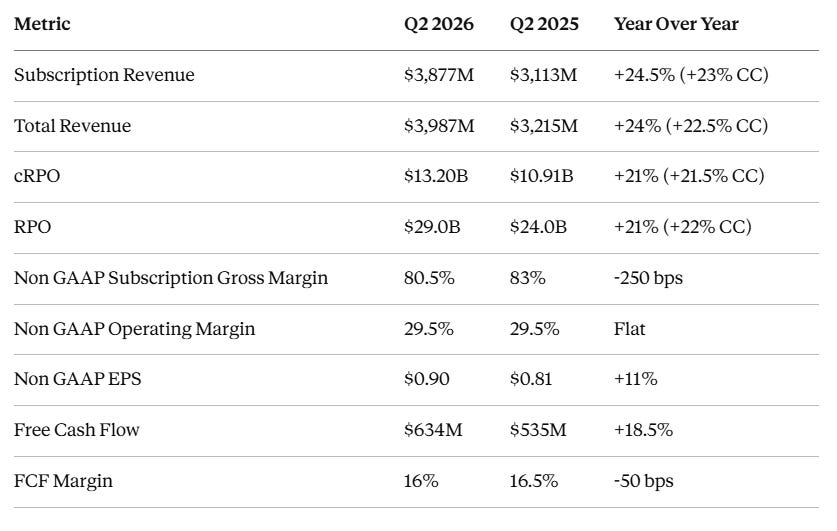
Subscription revenue accelerated to 23% constant currency growth from 19% in Q1, when Middle East on premise deal delays had weighed on the number. Management had called those delays a timing issue rather than a demand problem back in April, and this quarter is the evidence for that call. Large deal activity confirmed it. There were 123 transactions above $1 million in net new ACV, up nearly 40% year over year, and 658 customers now spending more than $5 million in ACV, up 23%. These are not the numbers of a platform losing relevance to AI. They are the numbers of a platform winning because of it.
The AI Milestone That Changes the Conversation
In April, ServiceNow raised its AI ACV target from $1 billion to $1.5 billion for the full year. The market heard the raise and largely shrugged, fixated instead on the Middle East headwind and the Armis price tag. In the release, the company announced AI ACV crossed $1 billion in Q2 alone, two quarters ahead of the original year end schedule, with AI net new ACV up more than 40% sequentially. Management confirmed the $1.5 billion full year target is firmly on track, and the path from there toward the 30% of total ACV the company has targeted from AI by 2030 now looks structurally easier than the climb to the first billion was.
The adoption data backs it up. First time agentic AI purchases among renewal customers doubled year over year, production deployments grew ninefold in nine months, and Pro Plus pricing uplift continues above 30%. Renewal rate ticked up to 98% from 97%. This is not discounted adoption. It is full priced, in production, and renewing.
The clearest proof of durability is L1 ITSM. Generally available since May, it now resolves 80 to 85% of service requests with zero human intervention. One airline customer runs its entire call volume, five million calls a year, on ServiceNow Voice AI. That is tickets closing themselves, not an assistant drafting a reply.
Otto launched in Q2, unifying Now Assist, Moveworks, and AI Experience into a single agent that routes and executes work across departments. It completes the Moveworks integration into one sellable SKU, which matters because it turns three separate acquisitions and product lines into a single thing a sales rep can put in front of a customer. Bundled products with a unified brand sell faster and renew cleaner than a patchwork of point solutions stitched together after the fact.
Build Agent reached general availability and extended to Cursor, Windsurf, Claude Code, and GitHub Copilot. Anthropic became the first design partner for Action Fabric, letting third party AI systems take action inside ServiceNow workflows. The platform is becoming a connector layer for enterprise AI broadly, not just its own models, which is the more interesting strategic move here. A company that lets competing AI systems plug into its workflows and take real actions is betting that the workflow layer, not the model layer, is where the durable value sits. If that bet is right, ServiceNow gets paid regardless of which model wins the underlying AI race.
McDermott’s line from the release said the company is operating to the Rule of 56 and well on its way to the Rule of 60, the combined growth plus FCF margin target for 2030 set in Las Vegas. At the current trajectory, that looks like a plan, not a hope. Taken together, the milestone, the adoption data, the product cycle, and the connector strategy are four separate pieces of evidence pointing at the same conclusion. This is not a company defending its AI narrative. It is a company that has stopped needing to.
Guidance and What It Implies
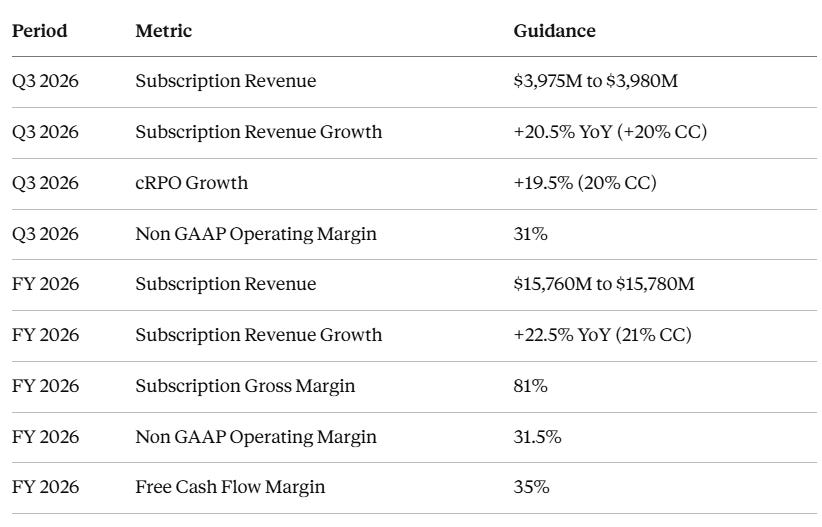
ServiceNow raised full year subscription revenue guidance for the second straight quarter, to $15.76 billion to $15.78 billion, a cumulative $220 million lift at the midpoint from where the year began. That new range also sits above where the Street had been modeling full year revenue heading into the print, and the sell side responded by nudging full year revenue estimates higher still in the hours after the release. Q3’s growth guide of 20.5% looks like a step down from Q2’s 24.5%, but management said roughly half the Q2 beat was Federal on premise deals pulled forward from Q3, and half was genuine net new ACV strength, which is why they still raised the full year number. This is the same non ratable revenue mechanic that made Q1 look weaker than the business was; here it works the other way.
The more important detail came from CFO callbacks after the print, and it addresses the loudest bear case heading into this quarter directly. That case argued the new pricing model effective July 1 pulled renewals forward artificially, meaning the cRPO strength was borrowed from Q3 rather than earned. Management said the opposite. Early renewals were driven by customers expanding into AI Control Tower, Security, and Risk, not by the pricing change, which is a far better reason for a customer to renew early. She framed a roughly 50 basis point cRPO stepdown from Q3 to Q4 as the reasonable modeling assumption, giving the second half cadence a clear yardstick. For readers who want the picture stripped of acquisition noise, organic cRPO growth excluding Moveworks and Armis was roughly 19.3%, with Armis contributing about 135 basis points on top and outperforming its own expectations. The company has beaten its cRPO guide in each of the last four quarters, which is the context worth keeping in mind before reading too much into any single quarter’s deceleration.
Margins, Cash Flow, and the Armis Overhead
GAAP and non GAAP tell different stories here, and it is worth separating them cleanly. GAAP subscription gross margin fell 650 basis points to 73.5%, almost entirely from $177 million in Armis intangibles amortization, an accounting drag tied to the acquisition that will persist for years and will distort the GAAP number for anyone reading it in isolation. Non GAAP subscription gross margin, which strips that amortization out, was 80.5%, down a real 250 basis points from 83% a year ago, driven by faster than expected hyperscaler migration costs and rising AI compute demand. This is worth tracking rather than dismissing. On the call, management said unit costs should decline as hyperscaler volume scales and expects better pricing over the medium term, and separately noted that the company prices on the solution delivered rather than on tokens consumed, so falling model costs flow to margin rather than into a repriced contract. Despite the pressure, operating margin held at 29.5%, three points above guidance and flat year over year, which is the clearest sign the compression is being managed rather than absorbed passively.
McDermott also committed to finishing 2026 and entering 2027 with the same headcount the company had before the Moveworks, Veza, and Armis acquisitions combined, zero net adds for three deals absorbed. If delivered, that is a real operating leverage lever for 2027.
Free cash flow margin of 16% in Q2 is well below the 35% full year target, which the company reaffirmed and which requires a much stronger second half, consistent with past seasonality. The balance sheet shows the acquisition cost. Long term debt rose from $1.49 billion to $5.44 billion, goodwill from $3.58 billion to $9.84 billion, funding the $7.75 billion Armis deal. The company still holds $4.66 billion in cash and generated $2.26 billion in first half operating cash flow, so the leverage is manageable, but the Rule of 60 path runs through successful Armis integration.
The Second Act
It is easy to talk about Armis purely as a financial overhang, and on the numbers alone it currently is one. But the earnings call revealed the strategic case behind the price tag. McDermott used his prepared remarks to answer a question he says investors keep raising in private meetings, which is whether ServiceNow is becoming a cybersecurity company. His answer was more direct than I expected. ServiceNow already runs a cybersecurity business generating more than $1 billion, which he described as the eighth largest cybersecurity business in the enterprise and the fastest growing among the top ten. The pitch stacks AI Control Tower, Armis, and Veza on top of the existing ITSM and ITOM core, and the numbers behind it are worth recording. An estimated 2.2 billion AI agents are entering the enterprise globally, each one a new identity that must be governed, and the world is headed toward 40 billion connected devices within four years, of which Armis already tracks 7 billion in real time. Every ungoverned device or identity is attack surface. McDermott went further than a routine investor pitch and predicted cybersecurity will be bigger than ServiceNow itself within a few years, which is either showmanship or a preview of how this company gets valued by 2028.
The proof points are already showing up in the customer list. The Department of the Air Force is expanding its deployment, Leidos is onboarding, and nearly all 50 states are now on the platform, a federal and defense pipeline that has historically been one of ServiceNow’s strongest segments. The $600 billion total addressable market management laid out in Las Vegas at the Financial Analyst Day included security, operational technology, and AI governance as distinct expansion vectors, not just ITSM. Armis, at $340 million in annual recurring revenue and growing above 50% at the time of acquisition, is the credential that opens that door, and it looks less like a bolt on and more like the anchor for a second act.
The Ecosystem Is Closing In
The partnership ecosystem, which I argued in May was becoming a structural moat, deepened further in Q2. NVIDIA (Project Arc, agentic governance from desktop to data center), Microsoft (AI Control Tower across Agent 365), AWS (over $1 billion in Marketplace transactions), Accenture (legacy cybersecurity migration), and Experian (onboarding and risk workflows) all announced integrations. Each one embeds ServiceNow deeper into the enterprise stack and raises switching costs. Anthropic as the first Action Fabric design partner stands out most, since it is a technical integration, not a press release.
The Bear Case, Addressed Honestly
A quarter this clean deserves a genuine search for what could still go wrong, so here is the full accounting rather than a highlight reel.
During the quarter Sanofi publicly promoted a do it yourself software strategy spanning its vendor stack, ServiceNow included, which is the AI displacement thesis in its most concrete form, a large enterprise claiming it can build with AI what it used to buy. Management’s response, relayed through analyst callbacks, was that this behavior remains rare and that portions of Sanofi’s plan are already being walked back. Worth watching, not worth panicking over on the evidence of one company’s press tour.
Separately, channel checks picked up complaints from some CIOs that the new SKU lineup announced this quarter amounts to a forced price increase. Management pushed back firmly. Customers can stay on existing SKUs at existing prices, and the Pro Plus tier upgrade is free. Their working theory is overzealous sales messaging rather than an actual repricing, and they committed to investigating internally, which is worth revisiting in next quarter’s channel work since pricing resentment tends to show up in renewal data with a lag.
On the numbers, the full year subscription gross margin guide came down 50 basis points to 81%, and the Q3 operating margin guide sits below where consensus had been modeling, prompting several sell side EPS trims in the mid single digit range. This is the cost side of the AI adoption story, and it is real. Headcount also grew 12% year over year with 725 net adds in the quarter, which means McDermott’s pledge to exit 2026 at pre acquisition headcount now requires meaningful absorption in the second half rather than being a formality. And Technology fell to 48% of net new ACV, down 4 points year over year, as CRM, Core Business, and Creator picked up share. Bulls will read that as successful diversification. Bears will read it as the core franchise maturing. Both readings are correct at once, and the diversification is the more important of the two.
The Stock and My Position
That entry three months ago now looks like the right moment to have leaned in. The price sat more than 50% below the all time high of $211.48, at a point when the market had all but concluded the AI disruption narrative would prove fatal to this business. That conclusion always struck me as premature. Heading into this print the stock had drifted back to the $95 to $96 range, still down roughly 38% year to date, and it closed Friday at $97.90, well below both my sense of intrinsic value and management’s own 2030 targets of $30 billion or more in subscription revenue, 30% of ACV from AI, and the Rule of 60 as the combined growth and free cash flow floor. At roughly 15x EV to 2027 free cash flow for a business still compounding near 20% organically, that multiple still embeds a discount this quarter went a long way toward disproving.
I am maintaining my position and watching the Q3 result closely. The Federal pull forward dynamic makes Q3 a slightly noisier read than usual, though management’s confidence in the Federal pipeline heading into the government’s largest quarter takes some of the edge off that concern. What I am really focused on for the next print is whether full year free cash flow margin actually tracks toward the 35% target, whether AI ACV keeps building toward the 1.5 billion commitment, whether the headcount flat pledge survives contact with the second half, and whether the cybersecurity business eventually gets the segment level disclosure it now clearly deserves. If McDermott is right that security ends up bigger than the core within a few years, the sum of the parts math on this company changes entirely, and nobody on the sell side is modeling it that way yet.
Disclosure. I am long ServiceNow. Nothing in this article constitutes financial advice. Please do your own research before making any investment decisions.
Nicely done, thanks. I'm a believer as well…